


North Carolina faces a pressing crisis as data released by the EPA and reviewed by the Marin & Murphy exposes alarming levels of PFAS contamination in the state's water sources. This sobering discovery demands immediate and proactive measures to safeguard public health from the severe risks associated with exposure to these hazardous substances. Understanding the detrimental impacts of PFAS like kidney cancer, testicular cancer, and ulcerative colitis requires residents stay informed, monitor PFAS levels, and recognize that the adverse health effects are paramount to confronting this critical threat and protecting North Carolina's vital water resources.
North Carolina PFAS Water Contamination Map
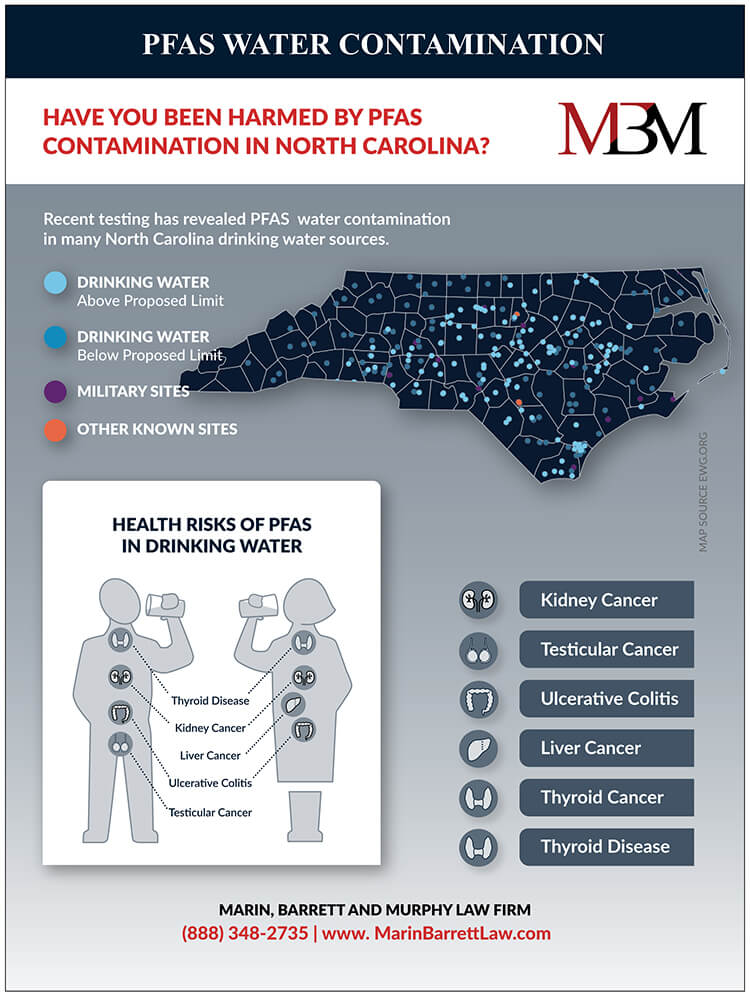
North Carolina PFAS Water Contamination Map & Cancer Risk Infographic
The North Carolina Department of Health and Human Services acknowledges, in a NC DHHS PFAS Fact Sheet released in 2024, that it now is known that some PFAS can cause serious health problems if you are exposed to them – even at low levels over a long period of time. Those serious health problems include an increased risk of kidney cancer, liver cancer, and testicular cancer as well as increased high blood pressure in pregnant people. Additionally, the EPA acknowledges that exposure to PFAS chemicals in drinking water has been linked to ulcerative colitis. We encourage those that have been harmed by PFAS water contamination to seek out experienced North Carolina PFAS cancer lawyers pursue claims against the manufacturers of these harmful forever chemicals.
Recent Developments in North Carolina PFAS Lawsuits
Update: September 27th, 2024 North Carolina PFAS Lawsuit Filed
A new lawsuit is shedding light on the serious health consequences of PFAS contamination in North Carolina. Known as “forever chemicals,” PFAS are linked to devastating illnesses, and Asheville resident Shawn R. is taking legal action after years of unknowingly consuming water tainted with these toxic substances. Click to view the official North Carolina PFAS lawsuit complaint filed by Shawn R. against major chemical manufacturers [PDF of North Carolina PFAS Lawsuit].
Shawn R.’s Case
- Who: Shawn R., a longtime resident of Asheville, North Carolina.
- Health Impact: Diagnosed with ulcerative colitis in 2020, Shawn R. underwent intensive medical treatments, including a total colectomy and ileostomy surgery. This condition has caused severe personal injuries, emotional distress, significant financial burdens, and ongoing health challenges.
- Source of Exposure: Shawn R. consumed water from municipal systems, including those in Asheville, NC; Orange, CA; and Chicago, IL, which were later found to contain high levels of PFAS chemicals.
PFAS Contamination in North Carolina
PFAS contamination in public water supplies is an urgent issue in North Carolina. Municipal water systems, including Asheville’s, have been found to contain dangerous levels of these toxic chemicals. PFAS are known for their ability to persist in the environment and accumulate in the human body, leading to long-term health risks such as cancer, ulcerative colitis, and other serious illnesses.
Defendants and Their Negligence
The lawsuit names numerous corporations as defendants, including:
- 3M Company
- DuPont de Nemours Inc.
- The Chemours Company
- BASF Corporation
- Tyco Fire Products
The defendants are accused of:
- Manufacturing and selling PFAS-laden products, including Aqueous Film-Forming Foam (AFFF), despite knowing the risks.
- Failing to warn the public about the harmful effects and persistence of these chemicals.
- Negligently allowing PFAS to seep into water supplies, resulting in contamination and widespread harm.
Why This Case Matters to North Carolina Residents
Shawn R.’s case highlights the risks PFAS contamination poses to residents across North Carolina. Those relying on municipal water systems may face similar exposure, leading to potential health problems and financial hardships. Holding corporations accountable is a critical step in addressing this public health crisis and preventing further harm.
What You Can Do: Protect Your Rights
If you or a loved one in North Carolina has suffered health issues due to PFAS-contaminated water, you may have legal options.
Information on PFAS Contamination in Drinking Water
Concerns over PFAS, or per- and poly-fluoroalkyl substances, contaminating drinking water have escalated in recent years. These contaminants have been found at concerning levels in various U.S. water supplies and have prompted actions by the Environmental Protection Agency (EPA) and other regulatory bodies.
While science continues to develop, studies have linked PFAS exposure to potential adverse health outcomes including kidney cancer, testicular cancer, and ulcerative colitis.. Monitoring PFAS levels in drinking water and implementing contamination mitigation strategies are essential to protect public health. Increased awareness and proactive measures are crucial in addressing this issue.
There is overwhelming evidence showing how PFAS is cancer-causing, such as kidney cancer, testicular cancer, and ulcerative colitis.
How to Deal with PFAS in your Drinking Water
Addressing PFAS contamination in drinking water is critical for protecting public health. Known for their hazardous health implications, PFAS contamination demands urgent attention.
Remediation methods, including activated carbon filters and reverse osmosis systems, can effectively reduce PFAS levels. Regular water quality monitoring is crucial to assess contamination levels and the effectiveness of remediation techniques.
It is also essential to stay informed about PFAS regulations and to advocate for more robust water safety standards. Increased public awareness and community action are pivotal in promoting cleaner drinking water.
Per- and Poly-Fluoroalkyl Substances (PFAS)
In North Carolina, PFAS-contaminated water sources have raised significant concerns about water quality and public health. PFAS have been linked to several health issues, including kidney cancer, testicular cancer, liver damage, ulcerative colitis, and immune system effects.
Health authorities recommend regular PFAS testing in water supplies to prevent these potential health hazards. Both public awareness and government regulation are critical in managing PFAS contamination and protecting communities.
Health Effects of PFAS Exposure
Research into PFAS exposure indicates significant health risks, including developmental delays, decreased fertility, compromised immune responses, and increased cancer risk. The environmental repercussions of PFAS extend beyond human health, impacting ecosystems significantly. Addressing the health impacts of PFAS is crucial for public health strategies and community protection.
PFAS Exposure Linked to Kidney Cancer in North Carolina
Recent research shows a strong connection between exposure to PFAS (per- and polyfluoroalkyl substances) and the development of renal cell carcinoma, commonly known as kidney cancer. One specific type of PFAS, called perfluorooctanoic acid (PFOA), has been particularly linked to kidney cancer. Numerous epidemiological studies consistently report that high levels of contact with PFOA disrupt cellular processes in the kidneys, potentially leading to malignant transformations. This evidence underscores the dangerous connection between PFAS and kidney cancer.
On January 26th, 2024 in a significant health alert, the Centers for Disease Control and Prevention (CDC) has released critical update on PFAS (per- and polyfluoroalkyl substances), with a specific focus on the increased risk of kidney cancer. This development is crucial for individuals considering filing a North Carolina PFAS Kidney Cancer Lawsuit. The CDC’s announcement highlights the need for heightened awareness and medical monitoring for those potentially impacted by PFAS exposure, aligning with the growing concerns related to PFAS and Kidney Cancer.
In North Carolina, kidney cancer remains a significant health concern. Data from the North Carolina Department of Health and Human Services indicate that the state has seen a rise in kidney cancer cases over recent years. Kidney cancer is more prevalent among older individuals, with the median age range for diagnosis being 65-69. Approximately 63% of all cases are diagnosed between the ages of 55-79, and kidney cancer is more common in men, with incidence and mortality rates nearly twice as high as in women. Annually, North Carolina records about 1,600 new cases of kidney cancer and approximately 340 deaths due to the disease.
If you have been diagnosed with kidney cancer and reside in North Carolina, long-term exposure to PFAS chemicals in your drinking water may be a contributing factor. All PFAS water contamination lawsuits have been centralized in Federal Court in Charleston, South Carolina. To pursue a claim, it is vitally important to hire an experienced water contamination injury attorney to represent you and assist you in filing a North Carolina PFAS kidney cancer lawsuit.
PFAS Exposure Linked to Testicular Cancer in North Carolina
Emerging research suggests a disturbing connection between PFAS exposure and an increased risk of developing testicular cancer. A major study has linked PFAS, often referred to as “forever chemicals” due to their persistence in the environment, to testicular cancer, highlighting a pressing public health issue.
PFAS substances, known for their use in firefighting foams and various consumer products, have infiltrated water supplies throughout North Carolina, raising alarms about widespread exposure concerns. Military bases in North Carolina, such as Camp Lejeune and Seymour Johnson Air Force Base, have faced scrutiny due to studies linking PFAS chemicals to testicular cancer among service members and surrounding civilians.
If you have been diagnosed with testicular cancer and reside in North Carolina, long-term exposure to PFAS chemicals in your local drinking water may be a contributing factor. All PFAS water contamination lawsuits have been centralized in Federal Court in Charleston, South Carolina. To effectively pursue a claim, it is vitally important to hire an experienced water contamination injury attorney to represent you and assist you in filing a North Carolina PFAS testicular cancer lawsuit.
PFAS Exposure Linked to Ulcerative Colitis in North Carolina
Recent studies have suggested a potential association between PFAS (per- and polyfluoroalkyl substances) exposure and an increased risk of developing ulcerative colitis. PFAS, found in various household products and industrial applications, have infiltrated water supplies, raising public health concerns in North Carolina. While more research is needed to fully understand the connection, these preliminary findings are crucial for those who may be at risk.
Key Points to Consider:
Immune System Impact: Scientific studies strongly suggest that exposure to PFAS can disrupt the immune system’s normal functioning, making it less effective. This disruption increases susceptibility to diseases like ulcerative colitis and raises concerns about long-term health complications.
Inflammation Trigger: PFAS chemicals have been identified as triggers of inflammation within the human body. This inflammatory response plays a pivotal role in the development and progression of ulcerative colitis.
Long-term Effects: Prolonged exposure to PFAS may lead to chronic immune dysregulation, further exacerbating the risk of developing or worsening ulcerative colitis.
In North Carolina, the incidence of ulcerative colitis has mirrored national trends, showing an upward trend over the past few decades. The prevalence and incidence rates for ulcerative colitis, a form of inflammatory bowel disease (IBD), have increased due to better diagnostic practices, greater awareness, and possibly environmental factors. On average, the incidence rate for ulcerative colitis in the U.S. is about 12 to 20 new cases per 100,000 people each year.
If you have been diagnosed with ulcerative colitis and reside in North Carolina, long-term exposure to PFAS chemicals in your drinking water might be a contributing factor. All PFAS water contamination lawsuits have been centralized in Federal Court in Charleston, South Carolina. To pursue a claim, it is essential to hire an experienced water contamination injury attorney to represent you and assist you in filing a North Carolina PFAS ulcerative colitis lawsuit.
PFAS Exposure Linked to Thyroid Cancer in North Carolina
Several case-control and nested case-control studies have examined the association between PFAS (per- and polyfluoroalkyl substances) exposure and the risk of thyroid disease. The results consistently demonstrate a positive association between elevated levels of specific PFAS, such as perfluorooctanoic acid (PFOA) and perfluorooctane sulfonate (PFOS), and an increased risk of papillary thyroid cancer. Longitudinal analyses have shown a dose-response relationship, further supporting the detrimental effects of PFAS on thyroid health.
These studies highlight the significant health risks posed by PFAS exposure. Whether it’s increasing the risk of thyroid cancer, causing developmental effects, or various other negative health impacts, PFAS pose a real threat to human health.
North Carolina’s Thyroid Cancer Statistics
In North Carolina, thyroid cancer is a significant health concern. According to the North Carolina Central Cancer Registry, the state has seen a steady rise in thyroid cancer cases, particularly among populations exposed to PFAS-contaminated water supplies. Areas near industrial sites, such as the Chemours Fayetteville Works facility, have shown higher levels of PFAS contamination, which may contribute to increased thyroid cancer rates.
If you have been diagnosed with thyroid cancer and reside in North Carolina, long-term exposure to PFAS chemicals in your drinking water might be a contributing factor. All PFAS water contamination lawsuits have been centralized in Federal Court in Charleston, South Carolina. To pursue a claim, it is crucial to hire an experienced water contamination injury attorney to represent you and assist you in filing a North Carolina PFAS thyroid cancer lawsuit.
PFAS Exposure Linked to Liver Cancer in North Carolina
Emerging research indicates a concerning connection between exposure to PFAS and an increased risk of liver cancer. PFAS, often referred to as “forever chemicals” due to their persistent nature, have been linked to various adverse health outcomes, including liver damage and cancer. These synthetic chemicals, found in numerous consumer products and industrial applications, have infiltrated water supplies, leading to widespread public health concerns.
The Impact of PFAS on Liver Health
Liver Damage and Cancer: PFAS exposure has been shown to cause significant liver damage, which can lead to liver cancer. Studies have demonstrated that these chemicals disrupt normal liver function by interfering with lipid metabolism and inducing oxidative stress, which can cause cellular damage and increase the risk of malignancy. PFOA and PFOS have been particularly associated with liver toxicity and carcinogenesis.
Mechanisms of Liver Carcinogenesis: The carcinogenic potential of PFAS in the liver is attributed to their ability to induce peroxisome proliferation, a process that can lead to hepatocellular carcinoma (HCC), the most common type of liver cancer. The persistent nature of PFAS means that they accumulate in the liver over time, causing chronic inflammation and damage that can eventually result in cancerous growths.
North Carolina’s Liver Cancer Statistics
In North Carolina, liver cancer represents a growing health concern, with the state seeing an increase in incidence rates over the past few decades. According to the North Carolina Central Cancer Registry, there has been a notable rise in liver cancer diagnoses, particularly among populations exposed to PFAS-contaminated water supplies. This trend underscores the urgent need for public health interventions and regulatory measures to address PFAS pollution.
If you have been diagnosed with liver cancer and reside in North Carolina, long-term exposure to PFAS chemicals in your drinking water might be a contributing factor. All PFAS water contamination lawsuits have been centralized in Federal Court in Charleston, South Carolina. To pursue a claim, it is crucial to hire an experienced water contamination injury attorney to represent you and assist you in filing a North Carolina PFAS liver cancer lawsuit.
Drinking Water Contamination in North Carolina
Effective management of drinking water contamination is paramount to mitigate health risks and ensure water safety. PFAS in drinking water significantly contributes to broad water quality issues, resulting in widespread contamination.
Addressing PFAS contamination involves monitoring and regulating its levels in drinking water to protect public health and prevent adverse effects. Investing in advanced water treatment technologies and establishing rigorous testing protocols are crucial steps toward resolving PFAS issues in drinking water.
During the settlement phase of the PFAS lawsuits brought by drinking water providers, drinking water providers in North Carolina were placed into two categories: Phase 1 providers and Phase 2 providers.
Phase 1 Water Providers in North Carolina
Phase 1 providers were defined as active water systems in the United States that have likely been impacted by PFAS water contamination. The Court identified these water providers as likely impacted by PFAS contamination:
- AHOSKIE, TOWN OF
- ALAN ACRES
- ALBEMARLE, CITY OF
- AMY ACRES S/D
- ANSON COUNTY WATER SYSTEM
- APPLEGATE WATER SYSTEM
- ASHEBORO, CITY OF
- ASHEBROOK PARK
- ASHEBROOK WOODS
- ASHEVILLE CITY OF
- ASHLEY HILLS S/D
- AURORA WATER SYSTEM
- AYDEN, TOWN OF
- BAKERSVILLE, TOWN OF
- BANNERTOWN HILLS S/D
- BARCLAY DOWNS S/D
- BAYLEAF MASTER
- BEAUFORT CO SOUTHSIDE
- BEAUFORT, TOWN OF
- BEECHWOOD COVE/POLKS LANDING
- BELHAVEN WATER SYSTEM
- BELL ARTHUR WATER CORPORATION
- BELLE MEADE S/D
- BELMONT, CITY OF
- BERKSHIRE DOWNS
- BESSEMER, CITY OF
- BETHAVEN WATER SYSTEM
- BEVERLY ACRES
- BLACK MOUNTAIN, TOWN OF
- BLADEN BLUFFS WATER SYSTEM
- BLADEN CO WTR DIST-EAST BLADEN
- BLADEN CO WTR DIST-WEST BLADEN
- BOLTON, TOWN OF
- BRENTWOOD S/D
- BRETTONWOOD HILLS S/D
- BREVARD, CITY OF
- BRIAR CREEK S/D
- BROOKWOOD COMMUNITY WATER SYSTEM
- BRUNSWICK COUNTY WATER SYSTEM
- SEWER H2GO
- BUFFALO SHOALS PARK
- BUNKER HILL ESTATES S/D
- BURLINGTON, CITY OF
- CABARRUS ACRES WATER SYSTEM
- CAMELOT S/D
- CANDY CREEK ESTATES
- CANTERBURY ESTATES
- CARDENS CREEK S/D
- CARDINAL ACRES
- CARMEL PARK
- CARTHAGE, TOWN OF
- CARY, TOWN OF
- CEDAR GROVE S/D
- CEDARWOOD ACRES
- CAPE FEAR PUBLIC UTILITIES AUTHORITY – WILMINGTON
- CHAPEL RIDGE S/D
- CHAPEL VIEW CIRCLE WATER SYS
- CHARLOTTE WATER
- CHATHAM CO-NORTH
- CHERRYVILLE, CITY OF
- CHESTERFIELD VILLAGE
- CHIPLEY PARK SD
- CHOCOWINITY WATER SYSTEM
- CHOWAN CO WATER SYSTEM
- CLEARVIEW ACRES S/D
- CLEVELAND COUNTY WATER
- CLIFFDALE WEST
- COLONIAL HEIGHTS-MALIBU S/D
- COLONIAL HEIGHTS-MEADOWBROOK
- COLUMBUS COUNTY WATER DIST III
- CONCORD, CITY OF
- COPELAND ACRES S/D
- COTTONWOOD S/D
- COUNTRY ACRES MH S/D
- COUNTRY CROSSING S/D
- COUNTRY MEADOWS
- COUNTRY SQUIRE ESTATES
- CRABTREE II S/D
- CREEKSIDE PLACE S/D
- CREEKSTONE S/D
- CRESTVIEW S/D
- CRESTVIEW S/D
- CROSS CREEK MHP
- DALLAS ACRES
- DALLAS, TOWN OF
- DANBURY, TOWN OF
- DARE CO-CAPE HATTERAS WATER
- DAVIDSON WATER INC
- DAVIE COUNTY WATER SYSTEM
- DEERPATH S/D
- DEERWOOD S/D
- DENTON, TOWN OF
- DIAMOND HEAD S/D
- DUAN ACRES WATER SYSTEM
- DUNN, CITY OF
- DUPLIN COUNTY WATER SYSTEM
- WATER SYSTEM
- DURHAM, CITY OF
- EAST CHESTNUT ST EXT
- EAST GASTON MHP
- EDEN, CITY OF
- EDENTON, TOWN OF
- EDGEWOOD S/D
- ELIZABETH CITY, CITY OF
- ELM CITY, TOWN OF
- EMERALD VILLAGE S/D
- ENOCH AVE & TURNER DR MHP
- FAIRFAX S/D
- FAITH, TOWN OF
- FARMWOOD S/D(COUNTRYWOODS S/D)
- FAYETTEVILLE PUBLIC WORKS COMM
- FIRST CRAVEN SANITARY DISTRICT
- FIVE OAKS S/D
- FLEETWOOD ACRES S/D
- FONTAIN VILLAGE
- FOREST ACRES
- FOX RIDGE S/D
- FOX RUN S/D
- FOX RUN S/D
- FRANKLINTON, TOWN OF
- FREEMONT PARK S/D
- FUQUAY-VARINA, TOWN OF
- GAYLEE VILLAGE
- GLENCROFT S/D
- GLENCROFT S/D
- GLYNNWOOD MHP
- GOLDSBORO, CITY OF
- GRAHAM, CITY OF
- GREEN MEADOWS/HEATHER ACRES SD
- GREEN PINES S/D
- GREENEVERS, TOWN OF
- GREENFIELD S/D
- GREENSBORO, CITY OF
- GREENVILLE UTILITIES COMM /COMMISSION
- GREENWOOD S/D
- GREYMOSS S/D
- GRIMESLAND, TOWN OF
- HAMLET WATER SYSTEM
- HANOVER DOWNS S/D
- HARBOR VIEW S/D
- HARDSCRABBLE S/D
- HARNETT REGIONAL WATER
- HARRELLSVILLE, TOWN OF
- HARRISBURG, TOWN OF
- HEATHER DOWNS MH S/D
- HEATHERSTONE WEST S/D
- HELMS WATER SYSTEM
- HENDERSON-KERR LAKE REGIONAL WATER
- HERITAGE WEST
- HERTFORD WATER SYSTEM
- HIDDEN CREEK ESTATES
- HIGH POINT, CITY OF
- HILL-N-DALE-LINCOLN VIEW S/D
- HILLSBOROUGH, TOWN OF
- HOLLY HILLS S/D
- HOLLY HILLS S/D
- HOLLY SPRINGS, TOWN OF
- HOMESTEAD PARK S/D
- HOMESTEAD S/D
- HOMESTEAD S/D WATER SYSTEM
- HUDSON MEADOWS S/D
- HUNTER`S RIDGE S/D
- HUNTWOOD MHP
- HYDE COUNTY WATER SYSTEM
- IDLEWILD PARK
- IDLEWOOD ACRES WATER SYSTEM
- JAMESTOWNE S/D WATER SYSTEM
- JOHNSTON CO-WEST
- KANNAPOLIS, CITY OF
- KELLY HILL S/D
- KIMBERLY COURT
- KING, CITY OF
- KINGS MOUNTAIN, TOWN OF
- KNOLLS III S/D
- KNOLLWOOD S/D
- LA GRANGE WATER SYSTEM
- LAKE WACCAMAW, TOWN OF
- LAKEWOOD ESTATES
- LANDSDOWN/EASTOVER S/D
- LAUREL WOODS S/D
- LEGEND HILLS S/D
- LEXINGTON, CITY OF
- LIBERTY, TOWN OF
- LINCOLN COUNTY WTP
- LINCOLNTON, CITY OF
- LITTLE RIVER RUN S/D
- LONG SHOALS WATER SYSTEM
- LUCAMA, TOWN OF
- LUMBERTON, CITY OF
- LYNNBANK ESTATES
- MAGNOLIA, TOWN OF
- MALIBU POINTE S/D
- MALLARD CROSSING S/D
- MALLARD HEAD S/D
- MAPLECREST S/D
- MARION, CITY OF
- MARS HILL, TOWN OF
- MARSHALL, TOWN OF
- MARTIN CO REGIONAL WASA
- MARTIN CO WATER & SEWER DIST I
- MASONWOODS S/D
- MAYODAN, TOWN OF
- MAYSVILLE, TOWN OF
- MEADOW VIEW ESTATES S/D
- MEDFIELD ESTATES S/D
- MICRO, TOWN OF
- MIDDLE CREEK ACRES S/D
- MIDDLE CREEK MASTER
- MILL RACE
- MOCKSVILLE, TOWN OF
- MONROE, CITY OF
- MONTGOMERY COUNTY WATER SYSTEM
- MOORE COUNTY PUBLIC UTILITIES IN PINEHURST
- MOORESVILLE TOWN OF
- MORGANTON CITY OF
- MOUNT AIRY, CITY OF
- MOUNT HOLLY, CITY OF
- MOUNT PLEASANT, TOWN OF
- MOUNTAIN CREEK WATER SYSTEM
- MOUNTAIN RIDGE ESTATES
- MOUNTAINBROOK S/D
- MURDOCK RD WATER SYSTEM
- NASHVILLE, TOWN OF
- NEUSE REGIONAL WATER & SEWER AUTHORITY
- NEUSE RIVER VILLAGE MHP
- NEW BERN, CITY OF
- NEW LIGHT MASTER
- NEWTON GROVE, TOWN OF
- NEWTON, CITY OF
- NORWOOD, TOWN OF
- OAK RIDGE VALLEY
- OAKLYN S/D
- OLD NORTH UTILITIES SERVICES / FORT BRAGG
- ONSLOW WTR AND SEWER AUTHORITY
- ORANGE WATER & SEWER AUTHORITY
- ORIENTAL WATER SYSTEM
- OXFORD PARK WATER SYSTEM
- PARADISE POINT S/D
- PASQUOTANK CO RO WATER SYSTEM
- PASQUOTANK COUNTY WATER SYSTEM
- PEAR MEADOWS S/D
- PEBBLE BROOK ACRES S/D
- PENDER COUNTY UTILITIES
- PERQUIMANS COUNTY WATER SYSTEM
- PHILLIPS LANDING S/D
- PIEDMONT TRIAD REGIONAL
- PILOT MOUNTAIN, TOWN OF
- PINE LAKES S/D
- PINE LEVEL, TOWN OF
- PINK HILL, TOWN OF
- PITTSBORO, TOWN OF
- POLKS TRAIL S/D
- PONDEROSA S/D
- PONDEROSA S/D
- PRESTIGE HEIGHTS
- RAIN TREE II FAYETTEVILLE PWC
- RAINTREE S/D
- RALEIGH, CITY OF
- REIDSVILLE, CITY OF
- RICHMOND COUNTY WATER SYSTEM
- RIDGECREST/BAKERSFIELD S/D
- RIDGEHAVEN S/D
- RIDGEVIEW PARK S/D
- RIVER MEADOWS S/D
- RIVERVIEW ESTATES
- RIVERVIEW NORTH
- ROANOKE RAPIDS SANITARY DIST
- ROBESON COUNTY WATER SYSTEM
- ROBIN`S WOOD
- ROCKINGHAM, CITY OF
- ROCKY MOUNT, CITY OF
- ROLLING RIDGE S/D
- ROSE HILL, TOWN OF
- ROSEBORO, TOWN OF
- ROSELAND HEIGHTS S/D
- ROSMAN, TOWN OF
- ROXBORO, CITY OF
- ROYAL ACRES S/D
- SADDLE RUN S/D
- SALISBURY-ROWAN
- SANFORD, CITY OF
- SELMA, TOWN OF
- SEVEN DEVILS, TOWN OF
- SHADOW OAKS S/D
- SHERWOOD FOREST S/D
- SHILOH S/D
- SILER CITY, TOWN OF
- SIMS, TOWN OF
- SKYLAND DR WATER SYSTEM
- SMITHFIELD, TOWN OF
- SNOW CREEK HEIGHTS WATER SYST
- AUTHORITY
- SOUTH MOUNTAIN S/D
- SOUTH PLANTATION S/D
- SOUTHERN OUTER BANKS WTR SYST
- SOUTHERN PINES, TOWN OF
- SOUTHERN WAYNE SANITARY DIST
- SOUTHFORK S/D
- SOUTHFORT S/D
- SOUTHGATE S/D
- SOUTHWICK S/D
- SOUTHWOOD S/D
- SPENCER FOREST
- SPENCER RD PARK
- SPRING SHORES
- SPRINGDALE MH S/D
- SPRINGDALE S/D
- SPRINGDALE SD
- SPRINGFIELD WATER SUPPLY
- SQUIRE ESTATES S/D
- STAGECOACH S/D
- STARMOUNT VILLAGE S/D
- STATESVILLE, CITY OF
- STONEHENGE S/D
- STONEHOUSE ACRES
- STONERIDGE MASTER
- STONEY CREEK S/D
- STONEY POINT WS/FAYETTEVILLE PWC
- STONEYBROOK ESTATES S/D
- SUN RIDGE FARM S/D
- SUNSET PARK S/D
- SURF CITY, TOWN OF
- SWEET BRIAR S/D
- SWIFT CREEK MASTER SYSTEM
- TARBORO, TOWN OF
- TAVERNIER SUBDIVISION
- TAYLORTOWN, TOWN OF
- THE CAPE MASTER SYSTEM
- THE MEADOWS S/D
- THE VILLAGE OF BALD HEAD ISLAND
- THOMASVILLE, CITY OF
- TRAPPER`S CREEK S/D
- TUCKASEIGEE WATER & SEWER AUTH
- TURKEY PEN MHP
- TURNER FARMS III & IV
- TWO RIVERS UTILITIES
- TYRRELL COUNTY WATER
- VALDESE, TOWN OF
- VALLEY WOODS MHP
- VALLEYDALE S/D
- WADE, TOWN OF
- WAGRAM, TOWN OF
- WALLACE, TOWN OF
- WALNUT TREE S/D
- WASHINGTON, CITY OF
- WAYNE WATER DISTRICTS
- WELDON WATER SYSTEM
- WEST JEFFERSON, TOWN OF
- WEST OAKS S/D
- WESTOVER S/D
- WESTSIDE HILLS S/D
- WHISPERING PINES
- WILDCAT CREEK S/D
- WILLOW CREEK S/D
- WILLOW HILL S/D
- WILSON, CITY OF
- WINDHAVEN S/D
- WINSTON-SALEM, CITY OF
- WOODBROOK S/D
- WOODCREEK S/D
- WOODLAKE WATER & SEWER INC
- WOODLAND RUN MH S/D
- WOODLEIGH S/D
- WOODRIDGE S/D
- WOODS OF ASHBURY SD
- WRIGHT & BEAVER RD MHP
- WRIGHTSVILLE BEACH WATER SYST
- WYNSTONE S/D
- WYNTREE S/D
- YADKINVILLE, TOWN OF
- YANCEYVILLE, TOWN OF
Phase 2 Water Providers in North Carolina
Phase 2 providers were defined as active water systems in the United States that could been impacted by PFAS water contamination. These providers, at the time of the settlement, may not have had ever tested for PFAS or have had not detected PFAS in their drinking water. The Court identified these North Carolina Phase 2 water providers, which may impacted by PFAS contamination in the future, as the following:
- ABERDEEN, TOWN OF
- ALEXANDER CO WTR DIST
- ANGIER, TOWN OF
- APEX, TOWN OF
- ARCHDALE, CITY OF
- ATLANTIC BEACH, TOWN OF
- BATON WATER CORPORATION
- BALD HEAD ISLAND (THE VILLAGE OF)
- BEAUFORT CO NORTHSIDE REGIONAL WATER
- BELVEDERE PLANTATION
- BENSON, TOWN OF
- BERTIE COUNTY REGIONAL WATER
- BLUE RIDGE WATER ASSOCIATION
- BOGUE BANKS WATER CORPORATION
- BOILING SPRINGS, TOWN OF
- BOONE, TOWN OF
- BRAGG COMMUNITIES/NTA
- BRENTWOOD WATER ASSOCIATION
- BRENTWOOD-JAMESTOWN ROAD
- BROAD RIVER WATER AUTHORITY
- BROADWAY WATER ASSOCIATION
- BRYSON CITY, TOWN OF
- BURGAW, TOWN OF
- BURKE CO. WATER-SOUTH
- BURNSVILLE, TOWN OF
- CALDWELL CO WATER SYSTEM-SE
- CALDWELL COUNTY WATER–WEST
- CANTON, TOWN OF
- CAROLINA BEACH WATER SYSTEM
- CAROLINA TRACE WATER SYSTEM
- CENTRAL NASH WATER & SEWER
- CFPUA/MONTEREY HEIGHTS
- CHINA GROVE, TOWN OF
- CHINQUAPIN WATER ASSOCIATION
- CLAYTON, TOWN OF
- CLINTON, CITY OF
- COLUMBUS CO WATER DISTRICT II
- CONNESTEE FALLS
- CONOVER, CITY OF
- CRAVEN COUNTY WATER SYSTEM
- CURRITUCK COUNTY WATER SYSTEM
- DAN RIVER WATER INC
- DARE COUNTY WATER SYSTEM
- DEEP RUN WATER CORPORATION
- EAST MOORE WATER DISTRICT
- EASTERN PINES WATER CORPORATION
- EASTOVER SANITARY DISTRICT
- EDGECOMBE WATER & SEWER DISTRICT
- ELIZABETHTOWN, TOWN OF
- ELKIN, TOWN OF
- ELON, TOWN OF
- ENERGY UNITED WATER CORP
- FAIRFIELD HARBOUR
- FAIRFIELD SAPPHIRE
- FARMVILLE, TOWN OF
- FLOWERS PLANTATION
- FOREST CITY, TOWN OF
- FORK TOWNSHIP SANITARY DISTRICT
- FRANKLIN COUNTY WATER & SEWER
- FRANKLIN, TOWN OF
- GATES COUNTY WATER SYSTEM
- GIBSONVILLE, TOWN OF
- GRANITE FALLS, TOWN OF
- GRASSY POND WATER CORPORATION
- GREENE CO REGIONAL WATER SYST
- GRIFTON, TOWN OF
- HALIFAX CO–HALIFAX
- HANDY SANITARY DISTRICT
- HARBOUR POINT S/D
- HAVELOCK WATER SYSTEM
- HENDERSONVILLE, CITY OF
- HERTFORD COUNTY RURAL WATER
- HICKORY CITY OF
- HIGHLANDS, TOWN OF
- HOKE CO REGIONAL WATER SYSTEM
- HOKE COUNTY REGIONAL WATER SYSTEM – ROCKFISH
- HOLDEN BEACH, TOWN OF
- ICARD TOWNSHIP WATER CORP
- IREDELL WATER CORPORATION
- JACKSONVILLE CITY OF
- JAMESTOWN, TOWN OF
- JOHNSTON COUNTY EAST WATER DEPARTMENT
- JONES COUNTY WATER SYSTEM
- JUNALUSKA SANITARY DISTRICT
- KILL DEVIL HILLS, TOWN OF
- KINSTON, CITY OF
- KURE BEACH WATER SYSTEM
- LAKE ROYALE S/D
- LAMPLIGHTER SOUTH-DANBY
- LAURINBURG, CITY OF
- LENOIR, CITY OF
- LILLINGTON WATER SYSTEM
- LITTLETON, TOWN OF
- LONGVIEW, TOWN OF
- LOUISBURG, TOWN OF
- LOWELL, CITY OF
- MAGGIE VALLEY SANITARY DIST
- MAIDEN, TOWN OF
- MEBANE, CITY OF
- MOREHEAD CITY, TOWN OF
- MOUNT OLIVE, TOWN OF
- MULBERRY-FAIRPLAINS WTR ASSOC
- MURFREESBORO, TOWN OF
- MURPHY, TOWN OF
- NEWPORT WATER SYSTEM
- NORTH LENOIR WATER CORPORATION
- NORTH WILKESBORO, TOWN OF
- NORTHAMPTON–LAKE GASTON
- NORTHAMPTON–MILWAUKEE
- OAK ISLAND, TOWN OF
- OCEAN ISLE BEACH, TOWN OF
- ORANGE-ALAMANCE WATER SYSTEM
- OXFORD, CITY OF
- PAMLICO COUNTY WATER
- PILGRIM’S PRIDE WATER SYSTEM
- PFEIFFER-N STANLY WATER ASSOC
- PINE KNOLL SHORES
- RAEFORD, CITY OF
- RANDLEMAN, CITY OF
- RANLO, TOWN OF
- RED SPRINGS, TOWN OF
- SAMPSON CO WTR DIST II
- SAWMILLS, TOWN OF
- SHALLOTTE, TOWN OF
- SHELBY, CITY OF
- SMITHFIELD FRESH MEATS CORP – TAR HEEL
- SOUTH CAMDEN WTR & SWR DISTRCT
- SOUTH GRANVILLE WATER AND SEWER AUTHORITY
- SOUTHPORT CITY OF
- SPRING LAKE, TOWN OF
- SPRUCE PINE, TOWN OF
- STANLEY, TOWN OF
- STANLY CO-WEST STANLY DIST
- STOKES REGIONAL WATER CORP
- TOWN OF CLAYTON – NORTH
- TROUTMAN, TOWN OF
- TROY, TOWN OF
- TRYON, TOWN OF
- UNION COUNTY WATER SYSTEM
- WADESBORO, TOWN OF
- WARREN COUNTY WATER SYSTEM
- WASHINGTON COUNTY WATER SYSTEM
- WAYNESVILLE, TOWN OF
- WEAVERVILLE, TOWN OF
- WEST CARTERET WATER CORP
- WEST IREDELL WATER CORPORATION
- WEST WILKES WTR ASSOCIATION INC
- WHISPERING PINES DEVELOPMENT
- WHITE LAKE, TOWN OF
- WHITEVILLE, CITY OF
- WILKESBORO, TOWN OF
- WILLIAMSTON, TOWN OF
- WILSON CO SOUTHEAST WATER DIST
- WILSON CO SOUTHWEST WATER DIST
- WINGATE, TOWN OF
- WINTERVILLE, TOWN OF
- WOODFIN SANITARY WATER AND SEWER
What are the potential long-term health effects of PFAS exposure in North Carolina?
Long-term health effects of PFAS exposure in North Carolina may include increased risks of certain cancers including kidney cancer, testicular cancer, liver cancer, liver damage, immune system dysfunction, ulcerative colitis and developmental delays in children. Ongoing monitoring and preventive measures are crucial. We firmly believe that those injured as a result of long-term exposure to PFAS water contamination should hire an experienced PFAS cancer lawyer and pursue claims against the manufacturers of these chemicals.
Are any specific communities in North Carolina particularly at risk for PFAS water contamination?
Yes, communities near military bases, industrial sites, and areas with historical use of firefighting foam are at heightened risk. These communities require targeted interventions and regular water quality assessments.
How does PFAS contamination in North Carolina compare to other states in the U.S.?
PFAS contamination in North Carolina mirrors challenges faced in different states, with similar public health and environmental risks. National standards and localized action are essential to address these persistent contaminants.
Contact Us For More Information
As Marin & Murphy continue to lead efforts in studying and addressing PFAS contamination in North Carolina, all stakeholders must engage actively in this battle. By advocating for stringent regulations, raising awareness, and implementing effective remediation techniques, we can ensure the safety and health of our communities. Let’s remain vigilant and proactive in protecting our water resources and public health from the pervasive threat of PFAS. For questions or to gather additional information, contact our PFAS cancer lawyers at 888-348-2735.
About the Author: PFAS Lawyer Matthew Marin
 Attorney Matthew Marin is a seasoned legal professional with a deep commitment to environmental justice and client advocacy, particularly in cases involving water contamination. A graduate of Roger Williams University School of Law, Matthew has been practicing law since 2008, focusing on environmental law and personal injury cases. With over 15 years of experience, he has honed his skills in litigating complex cases related to water quality and safety, earning a reputation for meticulous case preparation and tenacious representation. Matthew has successfully handled numerous cases involving PFAS in water supplies, securing favorable outcomes for his clients and contributing to the remediation of drinking water. His approach is characterized by thorough research, strategic planning, and a relentless pursuit of justice. Known for his compassionate approach, Matthew takes the time to understand each client’s unique situation, ensuring they feel heard and supported throughout the legal process. As member of the American Association for Justice and the National Trial lawyers, Matthew’s extensive knowledge and experience inform his work on the legal aspects of the AFFF & PFAS MDL litigation, water contamination, and environmental protection.
Marin & Murphy Law Firm is not currently accepting new PFAS claims. This page is general information about water quality and public health, not legal advice, and reading it or contacting the firm does not create an attorney-client relationship. The firm is licensed in South Carolina, Rhode Island, Massachusetts and Connecticut; its PFAS matters are handled with co-counsel who maintain local counsel arrangements nationwide. Matthew T. Marin, SC Bar #102771, 997 Morrison Drive, Suite 200, Charleston, SC 29403.
Other litigation affecting North Carolina residents: Marin & Murphy Law Firm is not currently accepting new PFAS claims, but is actively accepting cases in the North Carolina spinal cord stimulator lawsuit and the North Carolina Ozempic lawsuit.