



Colorado faces a severe public health crisis as data recently released by the EPA reveals alarming levels of PFAS contamination across the state's water sources. These hazardous substances, commonly found in commercial products, pose significant risks and demand immediate action to safeguard public well-being and the integrity of vital water resources. With challenges spanning contaminated groundwater and broader environmental impacts, Colorado must act swiftly and decisively to control PFAS exposure through continuous monitoring, effective filtration measures, and stringent adherence to health and environmental regulations. Tackling this pervasive contamination is paramount to ensuring access to clean, safe water statewide. Staying informed and taking decisive steps ensures access to clean, safe water statewide. Additionally, we encourage those that have been harmed by PFAS water contamination to seek out experienced Colorado PFAS cancer lawyers pursue claims against the manufacturers of these harmful forever chemicals.
Colorado PFAS Water Contamination Map
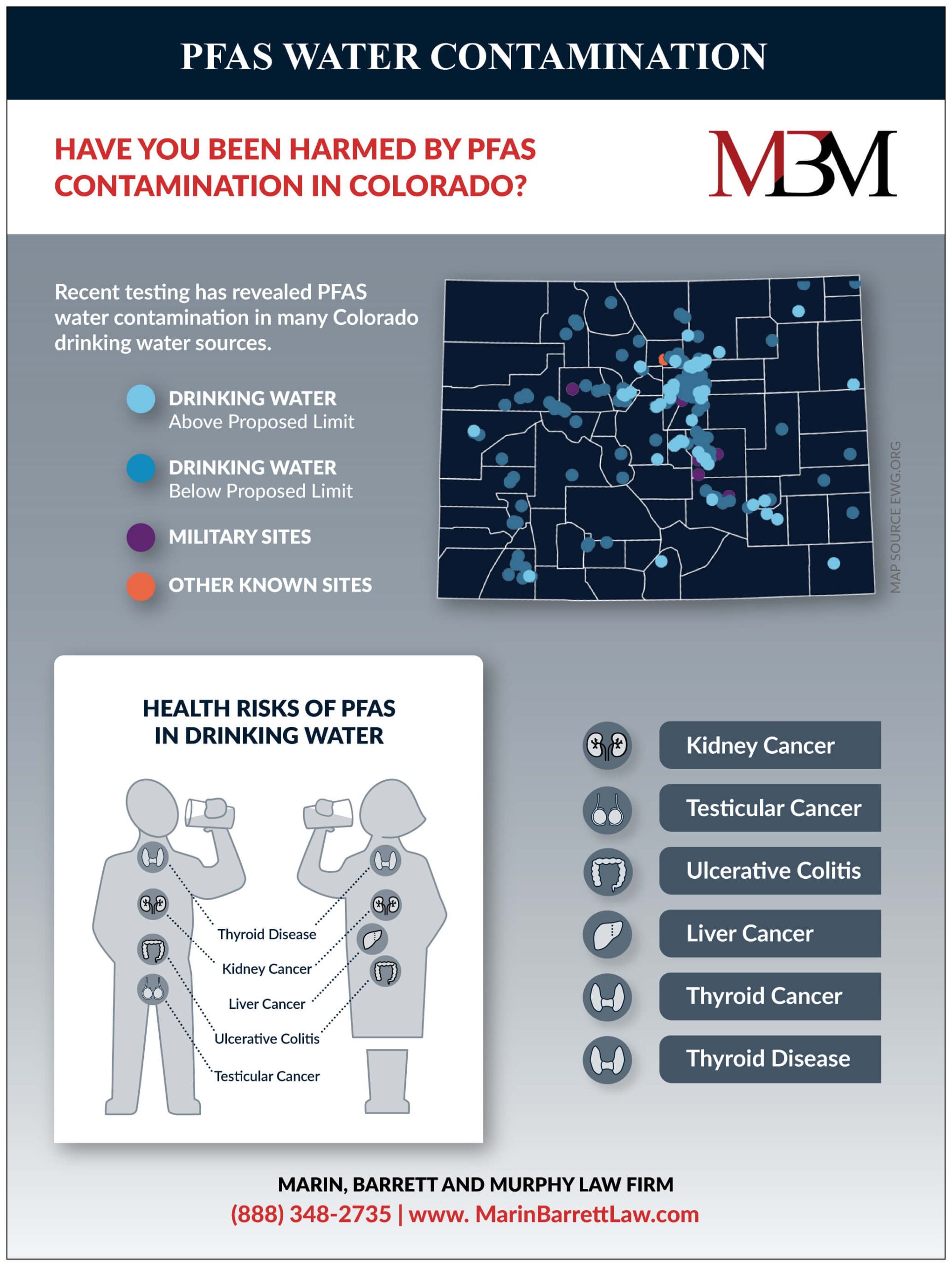
Colorado PFAS Water Contamination Map & Cancer Risk Infographic
Recent Developments in Colorado PFAS Lawsuits
Update: November 15th, 2024 Colorado PFAS Lawsuit Filed
A recent lawsuit highlights the serious health risks posed by PFAS contamination in Colorado’s drinking water. Known as “forever chemicals,” PFAS are linked to severe illnesses, and Colorado resident Brett P. is seeking justice after years of exposure to these toxic substances through his local water supply. Click to view the official Colorado PFAS lawsuit complaint filed by Brett P. against major chemical manufacturers [PDF of Colorado PFAS Lawsuit].
The Brett P.’s Case
- Who: Brett P. a resident of Erie, Colorado.
- Health Impact:
- Brett P. was diagnosed with kidney cancer in February 2024, requiring chemotherapy and ongoing treatment. His condition has caused significant physical and emotional suffering, as well as economic hardship due to mounting medical expenses. His wife has experienced loss of consortium and emotional distress, affecting their marital relationship.
- Source of Exposure: Brett P. regularly consumed water from municipal systems, including the City of Lafayette, which has been shown to contain harmful levels of PFAS chemicals.
PFAS Contamination in Colorado
The lawsuit underscores growing concerns about PFAS contamination in Colorado. Water supplies in Lafayette and surrounding areas have been identified as sources of exposure to these hazardous substances. PFAS chemicals persist in the environment and accumulate in the human body, leading to long-term health risks, including cancer and other chronic illnesses.
Defendants and Their Alleged Negligence
The lawsuit names several major corporations as defendants, including:
- 3M Company
- DuPont de Nemours Inc.
- The Chemours Company
- BASF Corporation
- Tyco Fire Products
These corporations are accused of:
- Manufacturing and distributing PFAS-containing products, such as Aqueous Film-Forming Foam (AFFF), without adequate warnings.
- Failing to prevent contamination of public and private water supplies.
- Neglecting to inform consumers of the persistent and toxic nature of their products, despite being aware of the risks.
Why This Matters to Colorado Residents
Brett P.’s case is not just an individual tragedy but part of a larger issue impacting communities across Colorado. Many residents who rely on municipal water systems may face similar risks of exposure to PFAS chemicals, which are known to cause serious health problems.
Take Action: Protect Your Rights
If you or a loved one in Colorado has been affected by PFAS-contaminated water, it’s important to take action.
Information on PFAS Contamination in Drinking Water
Marin & Murphy provide information on PFAS contamination in drinking water in Colorado.
PFAS contamination presents a considerable threat to the safety of drinking water supplies. These chemicals, prevalent in firefighting foams, nonstick cookware, and other consumer products, are found in groundwater and surface water, raising significant concerns about water quality and health risks. This situation underscores the necessity of stringent monitoring and regulation of PFAS levels in drinking water to protect public health. There is overwhelming evidence showing how PFAS is cancer-causing such as kidney cancer, testicular cancer, and ulcerative colitis
How to Deal with PFAS in your Drinking Water
Marin & Murphy provides information to help individuals deal with PFAS in their drinking water in Colorado.
Addressing PFAS in your drinking water involves proactive measures to ensure the safety of your water sources. Initiatives such as testing for PFAS contamination, utilizing certified water filters designed to reduce PFAS levels, and regular monitoring of water quality are crucial. Keeping yourself informed about the health risks associated with PFAS in drinking water is essential for making informed decisions regarding your water consumption.
Per- and Poly-Fluoroalkyl Substances (PFAS)
In Colorado, Marin & Murphy provide detailed information on Per- and poly-fluoroalkyl substances (PFAS).
Understanding the risks associated with per- and polyfluoroalkyl substances (PFAS) is vital for protecting public health. PFAS are a group of human-made chemicals used in a variety of industrial applications and consumer products that have been found in water sources across Colorado. The Environmental Protection Agency (EPA) has set advisory levels for certain PFAS in drinking water due to their potential adverse health impacts.
Health Effects of PFAS Exposure in Colorado
Examining the health effects of PFAS exposure is crucial for understanding the potential risks to public health and well-being. In Colorado, PFAS contamination has been detected in various water sources, raising significant public health concerns. Studies have linked PFAS exposure to increased cholesterol levels, immune system suppression, decreased infant birth weight, and changes in liver function. Additionally, there is moderate evidence suggesting PFAS can cause preeclampsia and high blood pressure during pregnancy, as well as effects on thyroid hormones. These findings underscore the importance of continuous monitoring and research to assess the full extent of health effects caused by PFAS exposure and to develop effective strategies for mitigating these risks.
PFAS Exposure Linked to Kidney Cancer
Recent research indicates a strong connection between PFAS exposure and renal cell carcinoma, or kidney cancer. Specifically, perfluorooctanoic acid (PFOA), a type of PFAS, has been linked to kidney cancer. Epidemiological studies have consistently reported that high levels of PFOA disrupt cellular processes in the kidneys, potentially leading to malignant transformations. In January 2024, the Centers for Disease Control and Prevention (CDC) released a critical update highlighting the increased risk of kidney cancer associated with PFAS exposure, stressing the need for heightened awareness and medical monitoring for those potentially impacted.
In Colorado, PFAS contamination has been a particular concern around military bases and industrial sites. For instance, the Suncor refinery in Commerce City has recorded PFAS levels in its discharge water that significantly exceed EPA health advisory levels, contributing to local water contamination issues. If you have been diagnosed with kidney cancer and reside in Colorado, it is important to consider the possibility of long-term exposure to PFAS chemicals in your drinking water. To pursue a claim, it is essential to hire an experienced water contamination injury attorney to assist you in filing a Colorado PFAS kidney cancer lawsuit.
PFAS Exposure Linked to Testicular Cancer
Emerging research suggests a disturbing connection between PFAS exposure and an increased risk of developing testicular cancer. Studies have linked PFAS chemicals, used in firefighting foams and various consumer products, to testicular cancer, highlighting a pressing public health issue. In Colorado, military installations and industrial sites have been sources of PFAS contamination, with significant implications for local residents.
If you have been diagnosed with testicular cancer in Colorado, it is important to consider the possibility of long-term exposure to PFAS chemicals in your local drinking water. To effectively pursue a claim, it is crucial to hire an experienced water contamination injury attorney to assist you in filing a Colorado PFAS testicular cancer lawsuit.
PFAS Exposure Linked to Ulcerative Colitis
Recent studies have suggested a potential association between PFAS exposure and an increased risk of developing ulcerative colitis, a form of inflammatory bowel disease (IBD). PFAS chemicals have been identified as instigators of inflammation within the human body, playing a pivotal role in the development and progression of ulcerative colitis. Prolonged exposure to PFAS may lead to chronic immune dysregulation, further exacerbating the risk of developing or worsening ulcerative colitis.
In Colorado, the incidence of ulcerative colitis has been on the rise, mirroring national trends. This increase is attributed to better diagnostic practices, greater awareness, and possibly environmental factors, including PFAS contamination in drinking water. If you have been diagnosed with ulcerative colitis in Colorado, it is important to consider the potential impact of PFAS exposure. To pursue a claim, it is essential to hire an experienced water contamination injury attorney to assist you in filing a Colorado ulcerative colitis lawsuit.
PFAS Exposure Linked to Thyroid Cancer
Several case-control and nested case-control studies have examined the association between PFAS exposure and the risk of thyroid cancer. These studies consistently demonstrate a positive association between elevated levels of specific perfluoroalkyl substances (PFAS), such as perfluorooctanoic acid (PFOA) and perfluorooctane sulfonate (PFOS), and an increased risk of papillary thyroid cancer. Additionally, longitudinal analyses have shown a dose-response relationship, further supporting the detrimental effect of PFAS on thyroid health.
These studies highlight the significant health risks posed by PFAS exposure. Whether it’s increasing the risk of thyroid cancer, causing developmental effects, or myriad other negative health effects, perfluoroalkyl substances pose a real threat to human health.
If you have been diagnosed with thyroid cancer and you live in Colorado, your diagnosis may be due to long-term exposure to PFAS chemicals in your drinking water. All PFAS water contamination lawsuits have been centralized in Federal Court in Charleston, South Carolina. To pursue a claim, it is vitally important to hire an experienced Colorado PFAS cancer attorney to represent you and assist you in filing a Colorado PFAS thyroid cancer lawsuit.
PFAS Exposure Linked to Liver Cancer
Emerging research indicates a concerning connection between exposure to PFAS (per- and polyfluoroalkyl substances) and an increased risk of liver cancer. PFAS, often called “forever chemicals” due to their persistent nature, have been linked to various adverse health outcomes, including liver damage and cancer. These synthetic chemicals, found in numerous consumer products and industrial applications, have infiltrated water supplies, leading to widespread public health concerns.
The Impact of PFAS on Liver Health
Liver Damage and Cancer: PFAS exposure has been shown to cause significant liver damage, which can lead to liver cancer. Studies have demonstrated that these chemicals disrupt normal liver function by interfering with lipid metabolism and inducing oxidative stress, causing cellular damage and increasing the risk of malignancy. Specific types of PFAS, such as perfluorooctanoic acid (PFOA) and perfluorooctane sulfonate (PFOS), are particularly associated with liver toxicity and carcinogenesis.
Mechanisms of Liver Carcinogenesis: The carcinogenic potential of PFAS in the liver is attributed to their ability to induce peroxisome proliferation, a process that can lead to hepatocellular carcinoma (HCC), the most common type of liver cancer. The persistent nature of PFAS means they accumulate in the liver over time, causing chronic inflammation and damage that can eventually result in cancerous growths.
Colorado’s Liver Cancer Statistics
In Colorado, liver cancer is a significant health concern. The state’s exposure to PFAS through contaminated drinking water supplies has likely contributed to liver health issues. According to the Colorado Department of Public Health and Environment, PFAS contamination has been detected in various water sources, including those near military bases and industrial sites.
If you have been diagnosed with liver cancer and reside in Colorado, it is possible that long-term exposure to PFAS chemicals in your drinking water is a contributing factor or the sole cause. All PFAS water contamination lawsuits have been centralized in Federal Court in Charleston, South Carolina. To pursue a claim, it is crucial to hire an experienced water contamination injury attorney to represent you and assist you in filing a Colorado PFAS liver cancer lawsuit.
PFAS Exposure Linked to Thyroid Disease in Colorado
Recent studies have demonstrated a significant association between PFAS exposure and various thyroid diseases, including hyperthyroidism, hypothyroidism, thyroiditis, Hashimoto’s disease, Graves’ disease, goiter, and thyroid nodules. PFAS chemicals, often termed “forever chemicals” due to their persistence in the environment, have been shown to interfere with thyroid function, leading to a range of health issues.
The Impact of PFAS on Thyroid Health
Hyperthyroidism and Hypothyroidism: PFAS exposure has been linked to both hyperthyroidism and hypothyroidism. Hyperthyroidism occurs when the thyroid gland produces excessive hormones, leading to symptoms like weight loss, rapid heartbeat, and nervousness. Conversely, hypothyroidism is characterized by insufficient hormone production, causing fatigue, weight gain, and depression. Studies suggest that PFAS can disrupt the endocrine system, leading to these thyroid dysfunctions.
Thyroiditis and Hashimoto’s Disease: Thyroiditis, an inflammation of the thyroid gland, and Hashimoto’s disease, an autoimmune form of thyroiditis, have also been associated with PFAS exposure. These conditions can cause thyroid gland damage, leading to chronic hypothyroidism. The inflammatory and immune responses triggered by PFAS are believed to play a role in the development of these conditions.
Graves’ Disease and Goiter: Graves’ disease, an autoimmune disorder resulting in hyperthyroidism, and goiter, an abnormal enlargement of the thyroid gland, have been linked to PFAS exposure as well. The disruption of normal thyroid function by PFAS can lead to overactivity of the thyroid gland or its enlargement as it attempts to compensate for hormonal imbalances.
Thyroid Nodules: PFAS exposure has been associated with the development of thyroid nodules, which are abnormal growths within the thyroid gland. While most nodules are benign, some can be precancerous or cancerous, highlighting the importance of monitoring thyroid health in individuals exposed to PFAS.
Colorado’s Thyroid Disease Statistics
In Colorado, thyroid diseases are a significant public health concern. The state’s residents have faced numerous cases of thyroid conditions, particularly among populations exposed to PFAS-contaminated water supplies. This trend underscores the urgent need for public health interventions and regulatory measures to address PFAS pollution.
If you have been diagnosed with a thyroid condition and reside in Colorado, it is possible that long-term exposure to PFAS chemicals in your drinking water is a contributing factor. All PFAS water contamination lawsuits have been centralized in Federal Court in Charleston, South Carolina. To pursue a claim, it is crucial to hire an experienced water contamination injury attorney to represent you and assist you in filing a Colorado PFAS thyroid disease lawsuit.
Drinking Water Contamination in Colorado
Effective management of drinking water contamination is crucial for ensuring public health and access to clean, safe water. In Colorado, the presence of PFAS in drinking water raises significant concerns about potential health risks and the environmental impact. Understanding sources of contamination is critical to mitigating adverse effects on water quality.
During the settlement phase of the PFAS lawsuits brought by drinking water providers, drinking water providers in Colorado were placed into two categories: Phase 1 providers and Phase 2 providers.
Phase 1 Water Providers in Colorado
Phase 1 providers were defined as active water systems in the United States that have likely been impacted by PFAS water contamination. The Court identified these Colorado water providers as likely impacted by PFAS contamination:
- ALDASORO RANCH HOC
- ANIMAS WC
- ARAPAHOE COUNTY WATER SYSTEM
- ARVADA CITY OF
- ASGARD SUBDIVISION WA
- AURORA CITY OF
- AVONDALE WATER AND SANITATION DISTRICT
- BASALT TOWN OF
- BATTLEMENT MESA MD
- BAXTER WATER & SERVICES
- BIG PINES CAMPGROUND
- BLUE RIVER VALLEY RANCH LAKES
- BLUE SKY RANCH INC ASSOC OF OWNERS
- BOULDER CITY OF
- BRIGHTON CITY OF
- BRUSH CITY OF
- BUENA VISTA TOWN OF
- BUFFALO MOUNTAIN METROPOLITAN DISTRICT
- CARBONDALE TOWN OF
- CHEROKEE METROPOLITAN DISTRICT
- CHEYENNE WELLS TOWN OF
- CLIFTON WD
- COLORADO CENTRE MD
- CONSOLIDATED MUTUAL MAPLE GROVE
- COPPER MOUNTAIN CONSOLIDATED MD
- CRAGMONT WC
- CROWLEY COUNTY WA
- CROWLEY COUNTY WS
- DEL NORTE TOWN OF
- DENVER WATER BOARD
- DILLON TOWN OF
- DILLON VALLEY DISTRICT
- EADS TOWN OF
- EAGLE RIVER VILLAGE MHP
- EAGLE RIVER WATER AND SANITATION DISTRICT
- EAGLES WATCH HOME OWNERS ASSOCIATION
- EAST CHERRY CREEK VALLEY WSD
- EAST DILLON WD
- EL RANCHO FLORIDA MD
- ELBERT CREEK WATER CO
- ELEPHANT ROCK MOBILE HOME PARK
- ELK MEADOWS ESTATES
- ENGLEWOOD CITY OF
- ERIE TOWN OF
- FALCON HEIGHTS POA
- FARMERS KORNER MHP
- FEDERAL HEIGHTS CITY OF
- FLORENCE CITY OF
- FOREST HILLS METROPOLITAN DISTRICT
- FOREST LAKES MD
- FORREST GROVE ESTATES
- FOUNTAIN CITY OF
- FOWLER TOWN OF
- FRASER TOWN OF
- FRISCO TOWN OF
- FT COLLINS CITY OF
- GENESEE WSD
- GOODMAN POA
- GRANADA WA
- GRAND JUNCTION CITY OF
- GRAND LAKE TOWN OF
- GREATROCK NORTH WATER AND SANITATION DISTRICT
- GREELEY CITY OF
- GREEN ACRES MHP
- GUNNISON CITY OF
- HEARTWOOD CO OP HOUSING
- HIGHLAND LAKES WATER DISTRICT
- HILLCREST VILLAGE MHP
- HOMESTEAD WATER COMPANY
- HOT SULPHUR SPRINGS TOWN OF
- HUGO TOWN OF
- IDLEDALE WATER AND SANITATION DISTRICT
- ILIUM VALLEY WS
- INDIAN HILLS WATER DISTRICT
- INVERNESS WSD
- JULESBURG TOWN OF
- KEENESBURG TOWN OF
- KEYSTONE RANCH
- KINGDOM PARK COURT
- LA JUNTA CITY OF
- LAFAYETTE CITY OF
- LAKE DURANGO WA
- LOCHBUIE TOWN OF
- MARBLE WC
- MERIDIAN MD
- MILLIKEN TOWN OF
- MONUMENT TOWN OF
- MOUNTAIN VIEW VILLAGE
- MOUNTAIN VIEW VILLAGE EAST
- MOUNTAIN VIEW VILLAGE WEST
- MOUNTAIN VILLAGE TOWN OF
- NORTHGLENN CITY OF
- OLDE STAGE WATER DISTRICT
- OLNEY SPRINGS TOWN OF
- PAGELS TP
- PANORAMIC MESA SUBD
- PARKER WATER AND SANITATION DISTRICT
- PEAKS SHADOW LLC
- PEETZ TOWN OF
- PERRY PARK WSD
- PINE BROOK HILLS WD
- PONCHA SPRINGS TOWN OF
- PUEBLO BOARD OF WW
- PUEBLO WEST MD
- RED SKY RANCH
- RICO TOWN OF
- RIFLE CITY OF
- RIO GRANDE WATER COMPANY
- RIVERBEND CABINS
- ROCKY FORD CITY OF
- ROSEWOOD HILLS PROPERTY HOA
- SAN LAZARO MFCTD HOUSING COMMUNITY
- SECURITY WATER DISTRICT
- SHAWNEE WCA
- SILT TOWN OF
- SILVERTHORNE TOWN OF
- SLEEPY BEAR MHP
- SOPRIS VILLAGE HOA
- SOUTH ADAMS COUNTY WSD
- SPRING VALLEY MUTUAL WATER DISTRICT
- SPRINGFIELD TOWN OF
- ST CHARLES MESA WD
- STERLING CITY OF
- STONEGATE METROPOLITAN DISTRICT
- STRATMOOR HILLS WSD
- SUGAR CITY TOWN OF
- TANGLEWOOD WATER SYSTEM
- TELLURIDE TOWN OF
- THORNTON CITY OF
- TODD CREEK VILLAGE METROPOLITAN DISTRICT
- TREE HAUS MD
- UPPER EAGLE REGIONAL WATER AUTHORITY
- UTE WCD
- VALLEY MAINT CORP NO 1
- WALDEN TOWN OF
- WATTENBURG IMPROVEMENT ASSOCIATION
- WESTBANK RANCH HOA
- WHITE HAVEN MHP
- WHITE HORSE SPRINGS WD
- WIDEFIELD WSD
- WOODEN DEER HOA
- YMCA ROCKIES WIND RIVER
Phase 2 Water Providers in Colorado
Phase 2 providers were defined as active water systems in the United States that could been impacted by PFAS water contamination. These providers, at the time of the settlement, may not have had ever tested for PFAS or have had not detected PFAS in their drinking water. The Court identified these Colorado Phase 2 water providers, which may be impacted by PFAS contamination in the future, as the following:
- ADVENIR FRENCH QUARTER
- ALAMOSA CITY OF
- ASPEN CITY OF
- BANCROFT CLOVER WSD
- BEAR CREEK WSD
- BERTHOUD TOWN OF
- BLACK HAWK CITY OF
- BRECKENRIDGE TOWN OF
- BROOMFIELD CITY AND COUNTY OF
- BURLINGTON CITY OF
- CANON CITY CITY OF
- CASTLE PINES NORTH MD
- CASTLE PINES VILLAGE MD
- CASTLE ROCK TOWN OF
- CENTENNIAL WSD
- CENTRAL CITY CITY OF
- CENTRAL WELD CNTY WD
- CHERRY CREEK VALLEY WSD
- CHERRY CREEK VILLAGE WD
- CHIPETA WD
- COLORADO SPRINGS UTILITIES
- CONIFER METRO DISTRICT
- CONSOLIDATED MUTUAL WATER COMPANY
- CORTEZ CITY OF
- COTTONWOOD WATER AND SANITATION DISTRICT
- CRAIG CITY OF
- CRESTVIEW WSD
- CSU FOOTHILLS CAMPUS
- CSU MAIN AND WEST HOUSING CAMPUS
- CSU SOUTH CAMPUS
- DACONO CITY OF
- DEER CREEK ELEMENTARY SCHOOL
- DELTA CITY OF
- DOMINION WSD
- DONALA WSD
- DURANGO CITY OF
- EAGLE TOWN OF
- EAST LARIMER COUNTY WD
- EATON TOWN OF
- EDGEWATER CITY OF
- EL JEBEL MOBILE HOME PARK
- ESTES PARK TOWN OF
- EVANS CITY OF
- EVERGREEN SOUTH
- FIRESTONE TOWN OF
- FREDERICK TOWN OF
- FT COLLINS LOVELAND WD
- FT LUPTON CITY OF
- FT MORGAN CITY OF
- GLENDALE CITY OF
- GLENWOOD SPRINGS CITY OF
- GOLDEN CITY OF
- GRAND COUNTY WATER NO 1
- GREEN MOUNTAIN WSD
- GYPSUM TOWN OF
- HAYDEN TOWN OF
- HIGH VIEW WD
- HUDSON TOWN OF
- IDAHO SPRINGS CITY OF
- JOHNSTOWN TOWN OF
- KEN CARYL WSD
- LAKEHURST WSD
- LAKEWOOD CITY OF
- LAMAR CITY OF
- LEFT HAND WD
- LIMON TOWN OF
- LITTLE THOMPSON WD
- LONGMONT CITY OF
- LOUISVILLE CITY OF
- LOVELAND CITY OF
- LYONS TOWN OF
- MANITOU SPRINGS CITY OF
- MESA CORTINA
- MENOKEN WD
- MERIDIAN SERVICE MD
- MID VALLEY MD
- MONTE VISTA CITY OF
- MONTEZUMA WC
- MONTROSE CITY OF
- MORGAN COUNTY QUALITY WD
- MORRISON TOWN OF
- MT WERNER WD
- NEW CASTLE TOWN OF
- NORTH TABLE MOUNTAIN WSD
- NORTH WASHINGTON STREET WSD
- NORTH WELD COUNTY WD
- NORTHERN COLORADO WA
- NORTHERN DOUGLAS COUNTY WSD
- ONEAL WATER SYSTEM
- PAGOSA AREA WSD
- PAINT BRUSH HILLS
- PARK CENTER WD
- PARKVILLE WD
- PINERY WWD
- PINEWOOD SPRINGS
- PLATTE CANYON WSD
- ROXBOROUGH WSD
- SALIDA CITY OF
- SEVERANCE TOWN OF
- SNAKE RIVER WD
- SNOWMASS VILLAGE WSD
- SOUTHGATE WSD
- SOUTHWEST METROPOLITAN WSD
- STEAMBOAT SPRINGS CITY OF
- SUPERIOR MD NO 1
- TRI COUNTY WCD
- TRINIDAD CITY OF
- TRIVIEW MD
- VAIL ASSOC MIDVAIL EAGLE
- VALLEY MAIN CORPORATION
- WELLINGTON TOWN OF
- WEST FORT COLLINS WD
- WESTMINSTER CITY OF
- WHEAT RIDGE WATER DISTRICT
- WILLOWBROOK WSD
- WILLOWS WD
- WINDSOR TOWN OF
- WINTER PARK WSD
- WOODLAND PARK CITY OF
- WOODMEN HILLS MD
- WOODMOOR WSD
- YUMA CITY OF
Frequently Asked Questions
What are the specific sources of PFAS water contamination in Colorado?
Industrial activities, firefighting foams, and landfill runoff are primary sources of PFAS contamination in Colorado. Addressing these sources is essential for mitigating environmental impact.
How does PFAS contamination affect vulnerable populations like children and pregnant women?
PFAS poses significant health risks to vulnerable groups, potentially leading to developmental problems and other health issues. Protecting these populations is a priority.
Are there any ongoing efforts or initiatives in Colorado to address PFAS contamination?
Yes, various initiatives, including enhanced testing and public awareness campaigns, are underway in Colorado to address PFAS contamination effectively.
What are the potential long-term health effects of PFAS exposure through contaminated drinking water?
Long-term exposure to PFAS can lead to severe health issues such as cancer, liver damage, and thyroid disease. Continuous monitoring and research are crucial.
How can individuals in Colorado test their drinking water for PFAS?
Residents can contact local health departments or certified laboratories to conduct PFAS testing on their drinking water.
Contact Us For More Information
Marin & Murphy are committed to combating PFAS water contamination in Colorado. By promoting rigorous water quality standards and holding polluters accountable, we strive to ensure a clean and safe water supply for all. Join us in this vital effort to protect our environment and public health. Our efforts are focused on holding responsible parties accountable and advocating for comprehensive environmental protection measures. For questions or to gather additional information, contact our PFAS cancer lawyers at 888-348-2735.
About the Author: PFAS Lawyer Matthew Marin
 Attorney Matthew Marin is a seasoned legal professional with a deep commitment to environmental justice and client advocacy, particularly in cases involving water contamination. A graduate of Roger Williams University School of Law, Matthew has been practicing law since 2008, focusing on environmental law and personal injury cases. With over 15 years of experience, he has honed his skills in litigating complex cases related to water quality and safety, earning a reputation for meticulous case preparation and tenacious representation. Matthew has successfully handled numerous cases involving PFAS in water supplies, securing favorable outcomes for his clients and contributing to the remediation of drinking water. His approach is characterized by thorough research, strategic planning, and a relentless pursuit of justice. Known for his compassionate approach, Matthew takes the time to understand each client’s unique situation, ensuring they feel heard and supported throughout the legal process. His extensive knowledge and experience inform his work on the legal aspects of water contamination and environmental protection.
Marin & Murphy Law Firm is not currently accepting new PFAS claims. This page is general information about water quality and public health, not legal advice, and reading it or contacting the firm does not create an attorney-client relationship. The firm is licensed in South Carolina, Rhode Island, Massachusetts and Connecticut; its PFAS matters are handled with co-counsel who maintain local counsel arrangements nationwide. Matthew T. Marin, SC Bar #102771, 997 Morrison Drive, Suite 200, Charleston, SC 29403.
Other litigation affecting Colorado residents: Marin & Murphy Law Firm is not currently accepting new PFAS claims, but is actively accepting cases in the Colorado spinal cord stimulator lawsuit and the Colorado Ozempic lawsuit.